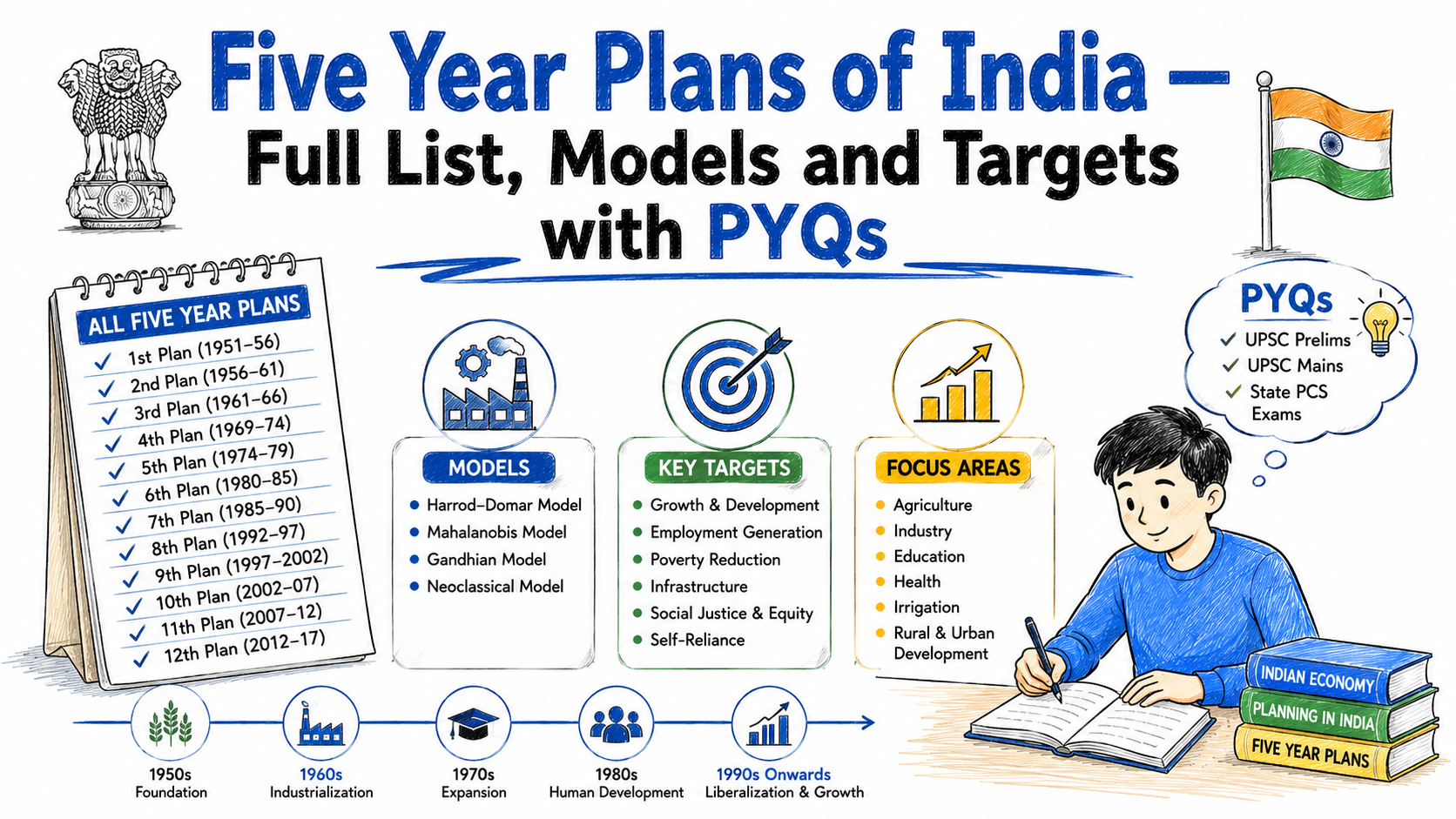
Five Year Plans look like a long list of dates, which is why most candidates skip the chapter. In reality only about six plans are asked, and they are asked in the same way every time — which plan followed which model, which plan failed and why, and which plan was the last one. This post gives the full list with years, focus and results, explains the two plan holidays, and ends with 15 real questions from past papers.
Key Points (Quick Revision)
- Planning Commission set up in 1950 by a cabinet resolution — not a constitutional body
- First Plan (1951-56) — Harrod-Domar model, focus on agriculture — successful
- Second Plan (1956-61) — Mahalanobis model, focus on heavy industry
- Twelfth Plan (2012-17) was the last Five Year Plan
- NITI Aayog replaced the Planning Commission on 1 January 2015
1. Who made the plans
The Planning Commission was set up in March 1950 by a resolution of the Union Cabinet. This one line answers a favourite exam question: it was neither a constitutional body nor a statutory body, because it was created by an executive decision and not by the Constitution or by an Act of Parliament.
The Prime Minister was its Chairman. The plans it drafted were approved by the National Development Council, set up in 1952, whose members included the Prime Minister, the Chief Ministers of all states and members of the Commission.
Economic and social planning is placed in the Concurrent List of the Constitution, which is why both the Centre and the states have a role in it.
2. First to Fifth Plan — the foundation years
| Plan | Years | Model and focus | Result |
|---|---|---|---|
| First | 1951-56 | Harrod-Domar model; agriculture, irrigation, power | Target 2.1%, achieved 3.6% — successful |
| Second | 1956-61 | Mahalanobis model; heavy and basic industry | Target 4.5%, achieved about 4.3% |
| Third | 1961-66 | Gadgil Yojana; self-reliant economy | Failed — two wars and drought |
| Fourth | 1969-74 | Growth with stability | Target 5.6%, achieved about 3.3% |
| Fifth | 1974-79 | Poverty removal and self-reliance | Ended a year early, in 1978 |
Three points from this table carry most of the marks. The First Plan is the only early plan that comfortably beat its target, and the Bhakra Nangal and Hirakud dam projects belong to it. The Second Plan built the steel plants — Bhilai with Soviet help, Rourkela with German help and Durgapur with British help. And the Third Plan failed because of the war with China in 1962, the war with Pakistan in 1965 and a severe drought.
The failure of the Third Plan led to the first Plan Holiday from 1966 to 1969, when three separate annual plans were run instead of a five year plan. The Fifth Plan was cut short in 1978 when the government changed, and a Rolling Plan was followed from 1978 to 1980.
📌 Exam Focus
- Asked most often: First Plan model (Harrod-Domar), Second Plan model (Mahalanobis), last plan (Twelfth)
- Common trap: the Planning Commission was not a constitutional or statutory body
- Remember the gaps: Plan Holiday 1966-69, Rolling Plan 1978-80, annual plans 1990-92
3. Sixth to Twelfth Plan — the reform years
| Plan | Years | Main focus |
|---|---|---|
| Sixth | 1980-85 | Poverty removal, modernisation; NABARD set up in 1982 |
| Seventh | 1985-90 | Food, work and productivity; Jawahar Rozgar Yojana |
| Eighth | 1992-97 | First plan after the 1991 reforms; human resource development |
| Ninth | 1997-2002 | Growth with social justice and equity |
| Tenth | 2002-07 | Doubling per capita income in ten years |
| Eleventh | 2007-12 | Faster and more inclusive growth |
| Twelfth | 2012-17 | Faster, more inclusive and sustainable growth |
There is a gap between the Seventh and Eighth Plans. Political instability and the balance of payments crisis meant that 1990 to 1992 were run as annual plans, and the Eighth Plan finally began in 1992, after the economic reforms of 1991. It went on to record the highest growth of any plan period.
Note the theme names, because questions quote them directly. The Eleventh Plan was titled Faster and More Inclusive Growth and the Twelfth Plan was titled Faster, More Inclusive and Sustainable Growth. The word that separates them is sustainable.
4. The end of planning and the rise of NITI Aayog
The Twelfth Plan, which ran from 2012 to 2017, was the last Five Year Plan India prepared. The system that produced them had already been replaced by then.
On 1 January 2015 the Planning Commission was dissolved and NITI Aayog — the National Institution for Transforming India — was created in its place.
| Planning Commission | NITI Aayog |
|---|---|
| Set up 1950 | Set up 1 January 2015 |
| Allocated funds to states | No power to allocate funds |
| Top-down planning | Advisory think tank, cooperative federalism |
| Chairman: Prime Minister | Chairperson: Prime Minister |
Like the body it replaced, NITI Aayog is neither a constitutional nor a statutory body. Its Chairperson is the Prime Minister, it is headed day to day by a Vice-Chairperson, and its Governing Council includes the Chief Ministers of all states and the Lieutenant Governors of union territories. Arvind Panagariya was its first Vice-Chairman. The key difference to remember is that the Planning Commission allocated money to states, while NITI Aayog only advises.
5. How it is asked in exams — 15 PYQs
- The Planning Commission was set up in which year? — 1950 (SSC CGL 2023)
- The First Five Year Plan was based on which model? — Harrod-Domar model (SSC CHSL 2023)
- The Second Five Year Plan was based on which model? — Mahalanobis model (SSC CGL 2022)
- Which plan gave priority to agriculture? — First Five Year Plan (SSC MTS 2023)
- Which plan focused on heavy industry? — Second Five Year Plan (RRB NTPC 2024)
- Plan Holiday was declared during which years? — 1966 to 1969 (SSC CGL 2024)
- Which was the last Five Year Plan of India? — Twelfth (2012-17) (SSC CHSL 2024)
- NITI Aayog was established on which date? — 1 January 2015 (SSC GD 2024)
- NITI Aayog replaced which body? — Planning Commission (RRB Group D 2024)
- Who is the Chairperson of NITI Aayog? — The Prime Minister (SSC MTS 2024)
- Which body approved the Five Year Plans? — National Development Council (SSC CPO 2023)
- The Third Five Year Plan failed mainly because of? — Wars and drought (SSC GD 2023)
- NABARD was established during which plan? — Sixth Five Year Plan (RRB NTPC 2025)
- Economic and social planning is in which list? — Concurrent List (SSC CGL 2023)
- Who was the first Vice-Chairman of NITI Aayog? — Arvind Panagariya (SSC CHSL 2022)
6. Quick Revision
⚡ Plans and gaps to fix in memory
- 1st (1951-56) Harrod-Domar · agriculture · succeeded
- 2nd (1956-61) Mahalanobis · heavy industry · steel plants
- 3rd (1961-66) Gadgil Yojana · failed — wars and drought
- Gaps: Plan Holiday 1966-69 · Rolling Plan 1978-80 · annual plans 1990-92
- 8th (1992-97) after 1991 reforms · highest growth
- 12th (2012-17) last plan · theme sustainable growth
- NITI Aayog 1 Jan 2015 · advisory only · PM is Chairperson
Frequently Asked Questions
Was the Planning Commission a constitutional body?
No. It was created in 1950 by a resolution of the Union Cabinet, not by the Constitution and not by an Act of Parliament, so it was neither a constitutional nor a statutory body. NITI Aayog, which replaced it, has the same status. This is one of the most frequently asked points from the chapter.
Why did the Third Five Year Plan fail?
Three shocks hit it together. The war with China in 1962 and the war with Pakistan in 1965 pushed spending toward defence, and a severe drought damaged agricultural output. The plan missed its targets badly, and the government responded by suspending five year planning for three years, a period known as the Plan Holiday.
What is the difference between the Planning Commission and NITI Aayog?
The Planning Commission prepared plans and allocated funds to the states, which gave it real financial power. NITI Aayog has no power to allocate funds and works as an advisory think tank built around cooperative federalism, with the states involved in shaping policy rather than receiving it. Both are chaired by the Prime Minister.
Which Five Year Plan was the last one?
The Twelfth Five Year Plan, which ran from 2012 to 2017, with the theme of faster, more inclusive and sustainable growth. No Thirteenth Plan was prepared, because the Planning Commission had already been replaced by NITI Aayog in January 2015 and the planning system was ended.
How many questions come from Five Year Plans in exams?
Usually one question per paper in SSC and Railway exams, and more in state services exams that carry a larger economy section. The questions concentrate on the first three plans, the last plan and NITI Aayog, so those five points are worth learning properly before anything else.
For more Economy topics in simple language, see the Economy section, and for related Polity notes try our Sources of the Indian Constitution post. Preparing for a specific exam? Start with the IBPS PO guide or join the 100 Hour GS Course.