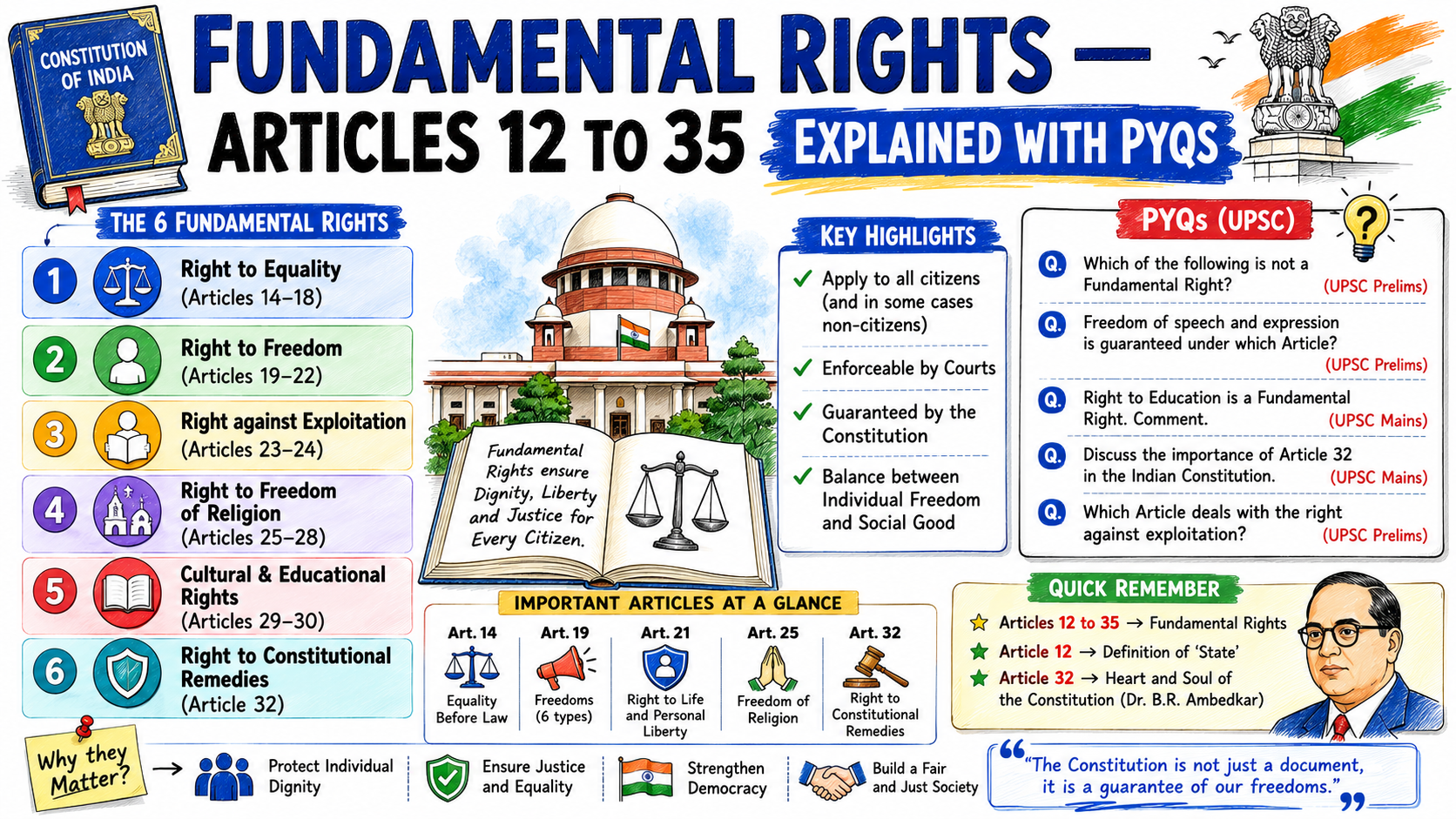
Fundamental Rights is the most asked chapter in Polity. Every exam takes 1 to 2 questions from here, and almost all of them ask one thing — which article covers which right. Once you fix the article numbers in your memory, the whole chapter becomes easy marks. This post explains all six rights in simple language, with the article numbers and 15 real questions from past papers.
Key Points (Quick Revision)
- Part III of the Constitution, Articles 12 to 35
- Originally seven rights; Right to Property was removed in 1978, leaving six
- Article 32 — Right to Constitutional Remedies, called the heart and soul of the Constitution by Dr Ambedkar
- Fundamental Rights are justiciable — you can go to court if they are violated
- Borrowed from the USA Constitution
1. The six Fundamental Rights
Start with this table. Most questions come directly from it.
| Right | Articles | What it means |
|---|---|---|
| Right to Equality | 14 to 18 | Equal treatment by law; no discrimination |
| Right to Freedom | 19 to 22 | Speech, movement, profession, personal liberty |
| Right against Exploitation | 23 to 24 | No forced labour or child labour |
| Right to Freedom of Religion | 25 to 28 | Practise and propagate any religion |
| Cultural and Educational Rights | 29 to 30 | Minorities can protect their culture and run institutions |
| Right to Constitutional Remedies | 32 | Go directly to the Supreme Court if a right is violated |
Remember one thing clearly. Right to Property is no longer a Fundamental Right. The 44th Amendment in 1978 removed it and made it a legal right under Article 300A. This is asked very often.
2. Right to Equality and Right to Freedom — article by article
| Article | Provision |
|---|---|
| Article 14 | Equality before law and equal protection of laws |
| Article 15 | No discrimination on religion, race, caste, sex or place of birth |
| Article 16 | Equal opportunity in public employment |
| Article 17 | Abolition of untouchability |
| Article 18 | Abolition of titles |
| Article 19 | Six freedoms including speech and expression |
| Article 20 | Protection in respect of conviction for offences |
| Article 21 | Protection of life and personal liberty |
| Article 21A | Right to Education for children aged 6 to 14 |
| Article 22 | Protection against arrest and detention |
Article 19 gives six freedoms: speech and expression, assembly, association, movement, residence, and profession. There were originally seven — the right to property was the seventh and was removed along with the property right in 1978.
Article 21A was not in the original Constitution. It was added by the 86th Amendment in 2002, making education a Fundamental Right for children aged 6 to 14.
📌 Exam Focus
- Asked most often: Article 32 (Constitutional Remedies), Article 21 (life and liberty), Article 17 (untouchability)
- Common trap: Right to Property — no longer a Fundamental Right, now Article 300A
- Remember: Article 21A (education) came by the 86th Amendment, 2002 — not original
3. Remaining rights — Articles 23 to 30
| Article | Provision |
|---|---|
| Article 23 | Prohibition of human trafficking and forced labour |
| Article 24 | No child below 14 in factories or hazardous work |
| Article 25 | Freedom of conscience and free profession of religion |
| Article 26 | Freedom to manage religious affairs |
| Article 27 | No tax for promoting any religion |
| Article 28 | No religious instruction in state-funded institutions |
| Article 29 | Protection of interests of minorities |
| Article 30 | Minorities' right to establish and administer educational institutions |
4. The five writs under Article 32
Article 32 lets you approach the Supreme Court directly. The court issues writs to protect your rights. High Courts have the same power under Article 226.
| Writ | Meaning | Used when |
|---|---|---|
| Habeas Corpus | To have the body | A person is unlawfully detained |
| Mandamus | We command | An official refuses to do their duty |
| Prohibition | To forbid | A lower court exceeds its jurisdiction |
| Certiorari | To be certified | To quash a lower court's order |
| Quo Warranto | By what authority | Someone holds a public office illegally |
Two writs are confused often. Prohibition stops a case that is still going on, while Certiorari cancels an order already passed. Habeas Corpus is the only writ that can be issued against both public authorities and private individuals.
5. How it is asked in exams — 15 PYQs
- Fundamental Rights are given in which part of the Constitution? — Part III (SSC CGL 2023)
- Which article is called the heart and soul of the Constitution? — Article 32 (SSC CHSL 2023)
- Untouchability is abolished under which article? — Article 17 (SSC MTS 2023)
- Right to Education was added by which amendment? — 86th Amendment, 2002 (RRB NTPC 2024)
- Right to Property was removed by which amendment? — 44th Amendment, 1978 (SSC CGL 2022)
- How many Fundamental Rights are there now? — Six (SSC GD 2024)
- Article 21 deals with? — Protection of life and personal liberty (SSC CHSL 2024)
- Which writ is issued against unlawful detention? — Habeas Corpus (SSC CPO 2023)
- Fundamental Rights are borrowed from which country? — USA (RRB Group D 2024)
- Article 24 prohibits? — Child labour in hazardous work (SSC MTS 2024)
- Which article guarantees equality before law? — Article 14 (SSC CGL 2024)
- Quo Warranto is issued when? — Someone holds public office illegally (RRB NTPC 2025)
- Right to Property is now covered under which article? — Article 300A (SSC CHSL 2022)
- Article 19 originally gave how many freedoms? — Seven (SSC GD 2023)
- Fundamental Rights cover which articles? — Articles 12 to 35 (SSC CGL 2023)
6. Quick Revision
⚡ Article numbers to fix in memory
- 14 equality before law · 17 untouchability abolished · 18 titles abolished
- 19 six freedoms · 21 life and liberty · 21A education (86th Amendment)
- 23 no forced labour · 24 no child labour under 14
- 25 to 28 religion · 29 to 30 minority rights
- 32 Constitutional Remedies — heart and soul · 226 same power for High Courts
- 300A Right to Property — legal right, not fundamental
Frequently Asked Questions
How many Fundamental Rights are there in India?
There are six Fundamental Rights today. The Constitution originally had seven, but the Right to Property was removed by the 44th Amendment in 1978 and made an ordinary legal right under Article 300A. This change is one of the most frequently asked facts from this chapter.
Why is Article 32 called the heart and soul of the Constitution?
Dr BR Ambedkar called it that because the other rights mean nothing without a way to enforce them. Article 32 lets a citizen approach the Supreme Court directly if a Fundamental Right is violated, and the court can issue five writs to protect it. High Courts have the same power under Article 226.
What is the difference between Prohibition and Certiorari?
Both are issued against lower courts, but at different stages. Prohibition stops a case while it is still going on, preventing a court from exceeding its jurisdiction. Certiorari is issued after an order has already been passed, to quash it. Exams often place these two together as options.
Is the Right to Education a Fundamental Right?
Yes. Article 21A makes free and compulsory education a Fundamental Right for children aged 6 to 14. It was not in the original Constitution and was added by the 86th Amendment in 2002, which is the detail exams usually ask about.
How many questions come from Fundamental Rights in exams?
Usually one to two questions per paper in SSC and Railway exams, making it the highest-yielding chapter in Polity. Most questions simply match an article number to a right, so learning the numbers properly covers almost the whole topic.
For more Polity topics in simple language, see our Sources of the Indian Constitution post and the Polity section. Preparing for a specific exam? Start with the Bihar Daroga guide or the 100 Hour GS Course.