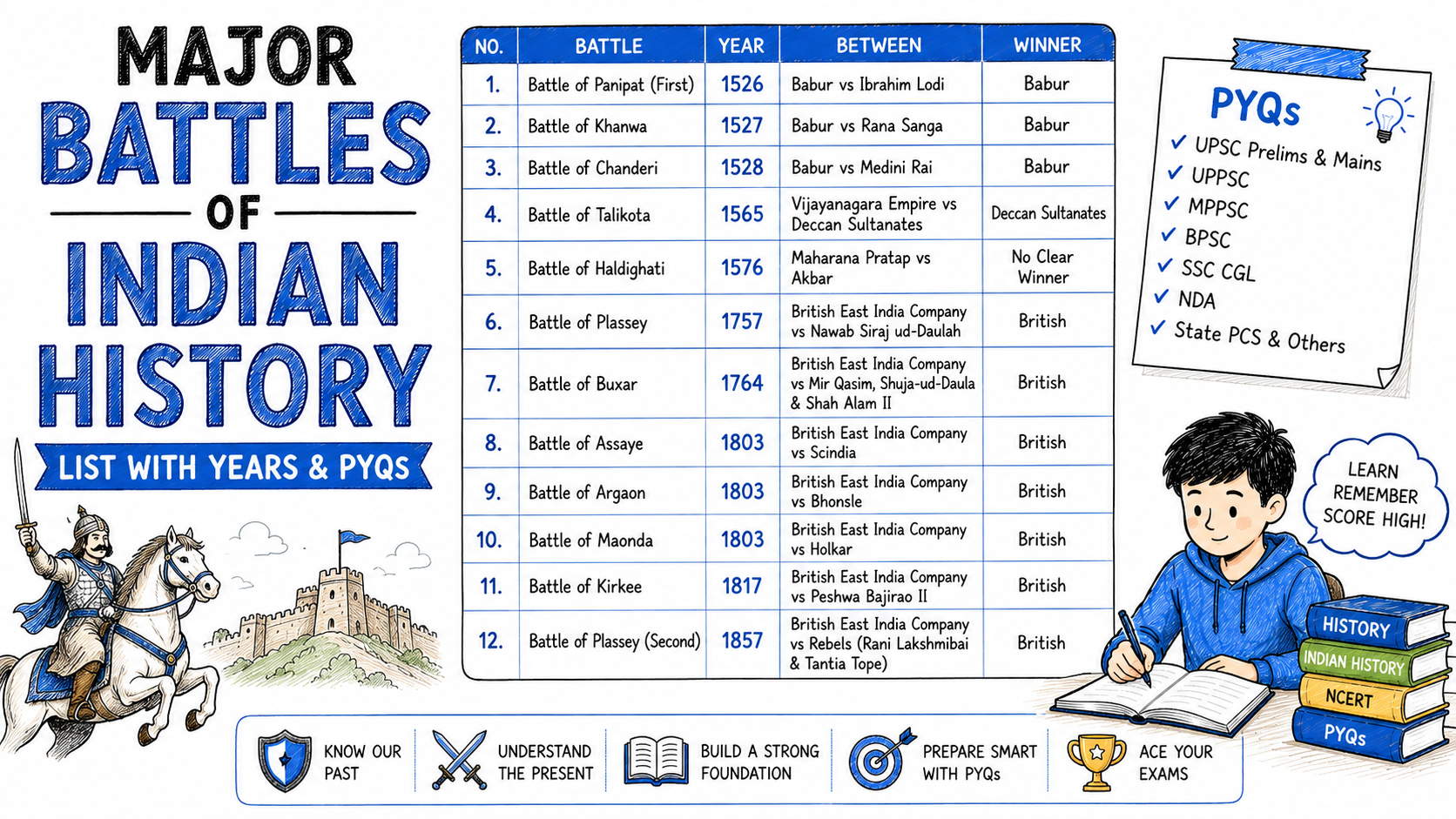
Battles look like a long list of dates, which is why most candidates leave the chapter for the last week. In reality the exam asks only about twenty battles, and it asks the same three things every time — who fought, who won, and what changed because of it. This post covers the major battles of Indian history in order, explains why the three Battles of Panipat all happened in the same place, and ends with 15 real questions from past papers.
Key Points (Quick Revision)
- Second Battle of Tarain (1192) — Muhammad Ghori defeated Prithviraj Chauhan, opening the way for Turkish rule
- First Battle of Panipat (1526) — Babur defeated Ibrahim Lodi and founded the Mughal Empire
- Third Battle of Panipat (1761) — Ahmad Shah Abdali broke Maratha power
- Plassey (1757) gave the British Bengal; Buxar (1764) gave them legal authority over it
- All three Panipat battles were fought in present-day Haryana
1. Ancient and early battles
These are few, but each one is asked directly.
| Battle | Year | Fought between | Result |
|---|---|---|---|
| Battle of the Ten Kings | Rigvedic period | Sudas of the Bharata tribe against a confederacy of ten tribes | Sudas won; fought on the Parushni (Ravi) river |
| Battle of Hydaspes | 326 BC | Alexander against Porus | Alexander won; fought on the Jhelum river |
| Kalinga War | 261 BC | Ashoka against Kalinga | Ashoka won, then turned to Buddhism |
| First Battle of Tarain | 1191 | Prithviraj Chauhan against Muhammad Ghori | Prithviraj Chauhan won |
| Second Battle of Tarain | 1192 | Muhammad Ghori against Prithviraj Chauhan | Ghori won |
| Battle of Chandawar | 1194 | Muhammad Ghori against Jaichand of Kannauj | Ghori won |
The two Battles of Tarain are the pair exams love, because the same two commanders fought twice with opposite results. Prithviraj Chauhan won in 1191 and lost in 1192. The second defeat is the important one, since it removed the main resistance in north India and led to the founding of the Delhi Sultanate.
The Kalinga War is asked for a different reason. It is the only major battle in Indian history remembered for what the winner did afterwards. The scale of the killing turned Ashoka away from war, and the change is recorded in his own edicts.
2. The three Battles of Panipat
Three separate battles, three different centuries, one place. Panipat lies in present-day Haryana on the route any invader takes toward Delhi from the north-west, which is why armies met there again and again.
| Battle | Year | Winner | Loser | Result |
|---|---|---|---|---|
| First Panipat | 1526 | Babur | Ibrahim Lodi | Mughal Empire founded; Lodi dynasty ended |
| Second Panipat | 1556 | Akbar, led by Bairam Khan | Hemu | Mughal rule firmly re-established |
| Third Panipat | 1761 | Ahmad Shah Abdali | Marathas under Sadashivrao Bhau | Maratha expansion broken |
The First Battle of Panipat is also remembered for how it was won. Babur had a much smaller army but used field artillery and a flanking movement, and this is generally treated as the first large-scale use of gunpowder artillery in an Indian battle.
The Third Battle of Panipat matters for what followed rather than for who ruled next. Abdali won but went back to Afghanistan. The Marathas lost so heavily that they could no longer hold north India, and the space that opened was eventually filled by the British.
📌 Exam Focus
- Asked most often: First Panipat 1526 (Babur and Ibrahim Lodi), Plassey 1757, Buxar 1764
- Common trap: First Tarain was won by Prithviraj Chauhan, Second Tarain by Muhammad Ghori
- Remember the difference: Plassey won Bengal in practice, Buxar won it in law through the Diwani
3. Battles of the Mughal era
| Battle | Year | Fought between | Result |
|---|---|---|---|
| Khanwa | 1527 | Babur against Rana Sanga | Babur won |
| Chanderi | 1528 | Babur against Medini Rai | Babur won |
| Ghaghra | 1529 | Babur against the Afghan chiefs | Babur won |
| Chausa | 1539 | Sher Shah Suri against Humayun | Sher Shah won |
| Kannauj (Bilgram) | 1540 | Sher Shah Suri against Humayun | Sher Shah won; Humayun went into exile |
| Talikota | 1565 | Deccan Sultanates against Vijayanagara | Vijayanagara defeated |
| Haldighati | 1576 | Akbar, led by Man Singh, against Maharana Pratap | Mughal side held the field |
| Samugarh | 1658 | Aurangzeb against Dara Shikoh | Aurangzeb won the succession war |
| Karnal | 1739 | Nadir Shah against Muhammad Shah | Nadir Shah won and carried away the Peacock Throne |
Two of these decide long stretches of history. Chausa and Kannauj together drove Humayun out of India for fifteen years and gave Sher Shah Suri the throne, and his short rule produced the administrative and revenue system the Mughals later built on.
Talikota ended the Vijayanagara Empire as a major power, and the capital city was sacked afterwards. Haldighati is asked slightly differently, because it was not a clean result — the Mughal army held the field, but Maharana Pratap escaped and continued fighting for years.
4. Battles that gave India to the British
Four battles turned a trading company into a ruling power. Learn them as a sequence, because each one follows from the last.
| Battle | Year | Fought between | Result |
|---|---|---|---|
| Colachel | 1741 | Travancore under Marthanda Varma against the Dutch | Dutch defeated; their power in India ended |
| Plassey | 1757 | Robert Clive against Siraj-ud-Daulah | British won after Mir Jafar changed sides |
| Wandiwash | 1760 | British under Eyre Coote against the French | French ambitions in India ended |
| Buxar | 1764 | British under Hector Munro against Mir Qasim, the Nawab of Awadh and the Mughal emperor | British won decisively |
| Seringapatam | 1799 | British against Tipu Sultan | Tipu Sultan was killed; Mysore fell |
The difference between Plassey and Buxar is the single most asked point in this section. Plassey was won largely by conspiracy rather than fighting, and it made the British the real power behind the Nawab of Bengal. Buxar was a genuine military victory against three rulers at once, including the Mughal emperor, and it settled the question in law.
What followed Buxar is the part to remember. The Treaty of Allahabad in 1765 gave the East India Company the Diwani, that is the right to collect revenue, in Bengal, Bihar and Odisha. From that point the Company was not merely influential in eastern India; it was the government's revenue authority there.
5. How it is asked in exams — 15 PYQs
- The First Battle of Panipat was fought in which year? — 1526 (SSC CGL 2023)
- Who defeated Ibrahim Lodi at Panipat? — Babur (SSC CHSL 2023)
- The Second Battle of Tarain was won by? — Muhammad Ghori (SSC MTS 2023)
- The Battle of Plassey was fought in? — 1757 (RRB NTPC 2024)
- Who betrayed Siraj-ud-Daulah at Plassey? — Mir Jafar (SSC CGL 2022)
- The Battle of Buxar was fought in which year? — 1764 (SSC GD 2024)
- The Third Battle of Panipat was fought between? — Ahmad Shah Abdali and the Marathas (SSC CHSL 2024)
- The Battle of Haldighati was fought between? — Akbar and Maharana Pratap (SSC CPO 2023)
- Which battle ended French power in India? — Battle of Wandiwash (RRB Group D 2024)
- The Kalinga War was fought by which ruler? — Ashoka (SSC MTS 2024)
- Alexander defeated Porus in which battle? — Battle of Hydaspes (SSC CGL 2024)
- The Battle of Khanwa was fought between? — Babur and Rana Sanga (RRB NTPC 2025)
- Which empire was defeated in the Battle of Talikota? — Vijayanagara (SSC CHSL 2022)
- The Treaty of Allahabad followed which battle? — Battle of Buxar (SSC GD 2023)
- All three Battles of Panipat were fought in which present-day state? — Haryana (RRB Group D 2023)
6. Quick Revision
⚡ Years and outcomes to fix in memory
- 1191 Tarain I — Prithviraj Chauhan won · 1192 Tarain II — Ghori won
- 1526 Panipat I — Babur beat Ibrahim Lodi · 1556 Panipat II — Akbar beat Hemu
- 1761 Panipat III — Abdali beat the Marathas
- 1527 Khanwa · 1539 Chausa · 1540 Kannauj · 1565 Talikota · 1576 Haldighati
- 1757 Plassey — Bengal in practice · 1764 Buxar — Bengal in law
- 1760 Wandiwash — French out · 1799 Seringapatam — Tipu Sultan killed
Frequently Asked Questions
Why were three battles fought at Panipat?
Panipat lies in present-day Haryana on the open plain north-west of Delhi, along the route every invader from Central Asia and Afghanistan had to take to reach the capital. The ground is flat and suits large armies with cavalry and artillery, so the defending force usually chose to meet the invader there rather than let the fighting reach Delhi.
What is the difference between the Battle of Plassey and the Battle of Buxar?
Plassey in 1757 was won mainly through the defection of Mir Jafar rather than through fighting, and it made the British the power behind the Nawab of Bengal. Buxar in 1764 was a real military victory over three rulers together, including the Mughal emperor, and it led to the Treaty of Allahabad, which gave the Company the right to collect revenue in Bengal, Bihar and Odisha.
Who won the Battle of Haldighati?
The Mughal army under Man Singh held the field, so it is usually recorded as a Mughal victory. But it settled nothing. Maharana Pratap escaped, kept fighting from the hills for years, and recovered much of his territory later, which is why the battle is often described as indecisive.
Which battle marked the beginning of Mughal rule in India?
The First Battle of Panipat in 1526, where Babur defeated Ibrahim Lodi and ended the Lodi dynasty. Babur won with a smaller army by using field artillery and a flanking movement, and this battle is generally treated as the first large-scale use of gunpowder artillery in Indian warfare.
How many questions come from battles in exams?
Usually one question per paper in SSC and Railway exams, and sometimes two in state examinations with a larger history section. The questions are highly repetitive, so about twenty battles with their years and outcomes cover almost everything that is asked.
For more History topics in simple language, see the History section, and for related Polity notes try our Sources of the Indian Constitution post. Preparing for a specific exam? Start with the SSC CGL guide or join the 100 Hour GS Course.