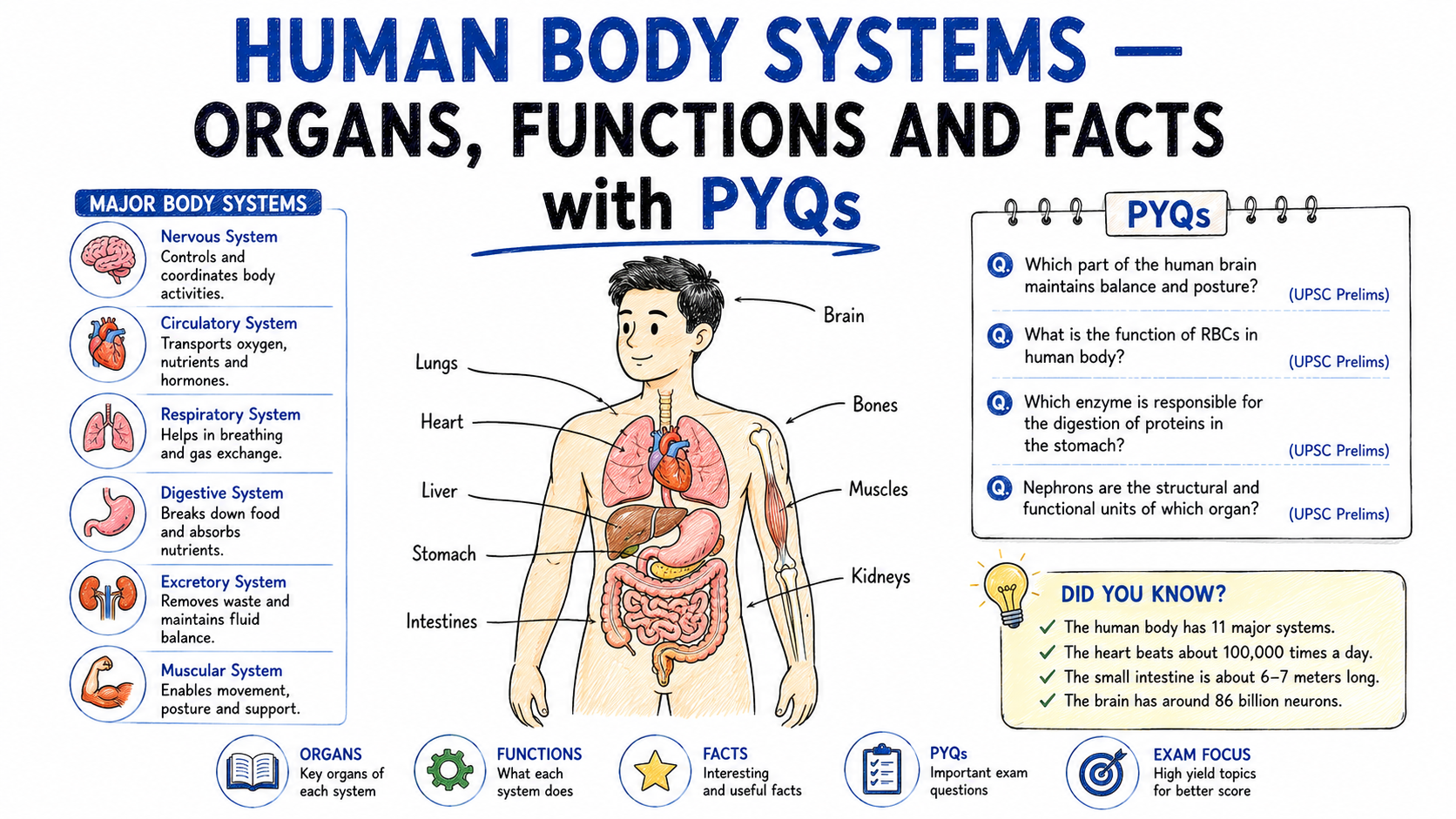
The human body is the most reliable scoring topic in General Science. Almost every exam asks one or two questions from it, and the questions rarely change — which is the largest gland, how many bones an adult has, which part of the brain controls balance. The facts are fixed and the list is short. This post covers every major body system with its organs and functions, and ends with 15 real questions from past papers.
Key Points (Quick Revision)
- An adult has 206 bones; a newborn has about 300
- Skin is the largest organ · Liver is the largest internal organ and largest gland
- Femur is the longest bone · Stapes (in the ear) is the smallest
- Pituitary is called the master gland
- Nephron is the functional unit of the kidney · Neuron of the nervous system
1. The major systems at a glance
Start here. If you learn only this table, you can answer most questions that name a system and ask for its main organ.
| System | Main organs | Main job |
|---|---|---|
| Skeletal | Bones, joints, cartilage | Support, shape, protection |
| Muscular | Muscles, tendons | Movement |
| Digestive | Stomach, intestines, liver, pancreas | Break down food, absorb nutrients |
| Respiratory | Nose, trachea, lungs, diaphragm | Exchange of gases |
| Circulatory | Heart, blood, blood vessels | Transport of oxygen and nutrients |
| Excretory | Kidneys, ureters, bladder | Remove waste from blood |
| Nervous | Brain, spinal cord, nerves | Control and coordination |
| Endocrine | Pituitary, thyroid, adrenal, pancreas | Control through hormones |
Two systems control the body, and exams like to separate them. The nervous system controls quickly through nerves, while the endocrine system controls slowly through hormones carried in the blood.
2. Skeletal and muscular systems
An adult human has 206 bones. A newborn baby has about 300, because many small bones join together as the child grows. This difference is asked often.
| Fact | Answer |
|---|---|
| Bones in an adult | 206 |
| Bones in a newborn | About 300 |
| Longest and strongest bone | Femur (thigh bone) |
| Smallest bone | Stapes (in the middle ear) |
| Largest muscle | Gluteus maximus |
| Smallest muscle | Stapedius |
| Teeth in an adult | 32 (20 milk teeth in a child) |
The three bones of the middle ear are the malleus, incus and stapes. The stapes is both the smallest bone in the body and part of this set, so one fact answers two questions.
📌 Exam Focus
- Asked most often: number of bones (206), largest gland (liver), master gland (pituitary)
- Common trap: largest organ is the skin, but largest internal organ is the liver
- Remember the pair: smallest bone and smallest muscle are both in the ear — stapes and stapedius
3. Digestive system
Food travels in one path: mouth, food pipe, stomach, small intestine, large intestine. Each part does one main job.
| Organ | What happens there |
|---|---|
| Mouth | Saliva starts digestion of starch |
| Stomach | Hydrochloric acid and enzymes act on protein |
| Small intestine | Digestion is completed and nutrients are absorbed |
| Large intestine | Water is absorbed; waste is formed |
| Liver | Makes bile, which breaks fat into small drops |
| Pancreas | Sends digestive juice and also makes insulin |
Three facts from this system repeat every year. The liver is the largest gland and the largest internal organ. Bile is made by the liver but stored in the gall bladder. And the small intestine is the longest part of the food canal, about six metres, which is where most absorption happens.
The pancreas is special because it does two jobs. It sends digestive juice into the intestine, and it also releases insulin directly into the blood. Lack of insulin causes diabetes.
4. Circulatory and respiratory systems
The heart has four chambers — two atria on top and two ventricles below. An adult has about five to six litres of blood, and a resting heart beats about 72 times a minute.
| Fact | Answer |
|---|---|
| Chambers in the heart | Four |
| Life of a red blood cell | About 120 days |
| Where RBCs are made | Bone marrow |
| Graveyard of RBCs | Spleen |
| Gas carrier in blood | Haemoglobin (contains iron) |
| Universal donor / recipient | O negative / AB positive |
| Normal blood pressure | 120/80 mm Hg |
Blood groups were discovered by Karl Landsteiner. Red blood cells carry oxygen, white blood cells fight infection, and platelets help blood to clot.
In the respiratory system, air passes through the nose, windpipe and bronchi to reach the lungs. The actual exchange of oxygen and carbon dioxide happens in tiny air sacs called alveoli. The main muscle of breathing is the diaphragm. The right lung has three lobes and the left lung has two, because the heart takes up space on the left side.
5. Nervous, excretory and endocrine systems
The nervous system is made of the brain, the spinal cord and the nerves. Its unit is the neuron, which is also the longest cell in the human body.
| Brain part | Controls |
|---|---|
| Cerebrum | Thinking, memory, intelligence — largest part |
| Cerebellum | Balance and coordination of movement |
| Medulla oblongata | Heartbeat, breathing, involuntary actions |
| Hypothalamus | Body temperature, hunger and thirst |
In the excretory system, the kidneys filter the blood and the functional unit is the nephron. Each kidney has about a million of them. One point catches candidates out: urea is made in the liver, not in the kidney. The kidney only removes it.
| Gland | Hormone | Note |
|---|---|---|
| Pituitary | Growth hormone and others | Master gland |
| Thyroid | Thyroxine | Needs iodine; lack causes goitre |
| Adrenal | Adrenaline | Called the emergency hormone |
| Pancreas | Insulin | Controls blood sugar |
The pituitary is called the master gland because it controls several other glands. The adrenal gland is called the emergency gland because adrenaline prepares the body for sudden action.
6. How it is asked in exams — 15 PYQs
- How many bones are there in an adult human body? — 206 (SSC CGL 2023)
- Which is the largest gland in the human body? — Liver (SSC CHSL 2023)
- Which is the largest organ of the human body? — Skin (SSC MTS 2023)
- Which is the smallest bone in the human body? — Stapes (RRB Group D 2024)
- Which gland is called the master gland? — Pituitary (SSC CGL 2022)
- What is the functional unit of the kidney? — Nephron (SSC GD 2024)
- Exchange of gases in the lungs takes place in? — Alveoli (RRB NTPC 2024)
- Which part of the brain controls balance? — Cerebellum (SSC CHSL 2024)
- What is the lifespan of a red blood cell? — About 120 days (SSC CPO 2023)
- Insulin is secreted by which organ? — Pancreas (SSC MTS 2024)
- Who discovered blood groups? — Karl Landsteiner (SSC CGL 2024)
- Bile is stored in which organ? — Gall bladder (RRB Group D 2023)
- Which is the longest bone in the human body? — Femur (SSC GD 2023)
- Which blood group is the universal donor? — O negative (RRB NTPC 2025)
- Urea is produced in which organ? — Liver (SSC CHSL 2022)
7. Quick Revision
⚡ Numbers and names to fix in memory
- 206 bones in adult · 300 in newborn · 32 teeth · 4 heart chambers
- Largest: organ — skin · internal organ and gland — liver · bone — femur · muscle — gluteus maximus
- Smallest: bone — stapes · muscle — stapedius · Longest cell: neuron
- Units: kidney — nephron · nervous system — neuron
- Glands: pituitary master · thyroid needs iodine · adrenal emergency · pancreas insulin
- Made in liver, removed by kidney: urea
Frequently Asked Questions
Why does a newborn have more bones than an adult?
A newborn has about 300 bones, many of which are made of soft cartilage. As the child grows, several of these small bones fuse together into single larger bones, leaving 206 in an adult. The skull and the spine account for much of this fusion.
What is the difference between the largest organ and the largest internal organ?
The skin is the largest organ of the human body by area and weight, but it is on the outside. Among the organs inside the body, the liver is the largest, and it is also the largest gland. Exams often place skin and liver together as options to see whether you noticed the word internal.
Which system controls the body — nervous or endocrine?
Both do, but in different ways. The nervous system sends fast electrical messages through nerves, so its effect is immediate and short-lived. The endocrine system sends hormones through the blood, so its effect is slower but lasts much longer. Growth and metabolism are controlled by hormones, while reflex actions are controlled by nerves.
Where is urea formed in the human body?
Urea is formed in the liver, from the breakdown of excess protein. It then travels in the blood to the kidneys, which filter it out and pass it into urine. Candidates often answer kidney because that is where urea leaves the body, but the question asks where it is produced.
How many questions come from the human body in exams?
Usually one to two questions per paper in SSC and Railway exams, and the science portion of most state exams. The questions are highly repetitive, so the same short list of numbers, largest and smallest facts, and gland names covers nearly all of them.
For more General Science topics in simple language, see the General Science section, and for related Static GK lists try our Indian Awards and Honours post. Preparing for a specific exam? Start with the RRB Group D guide or join the 100 Hour GS Course.