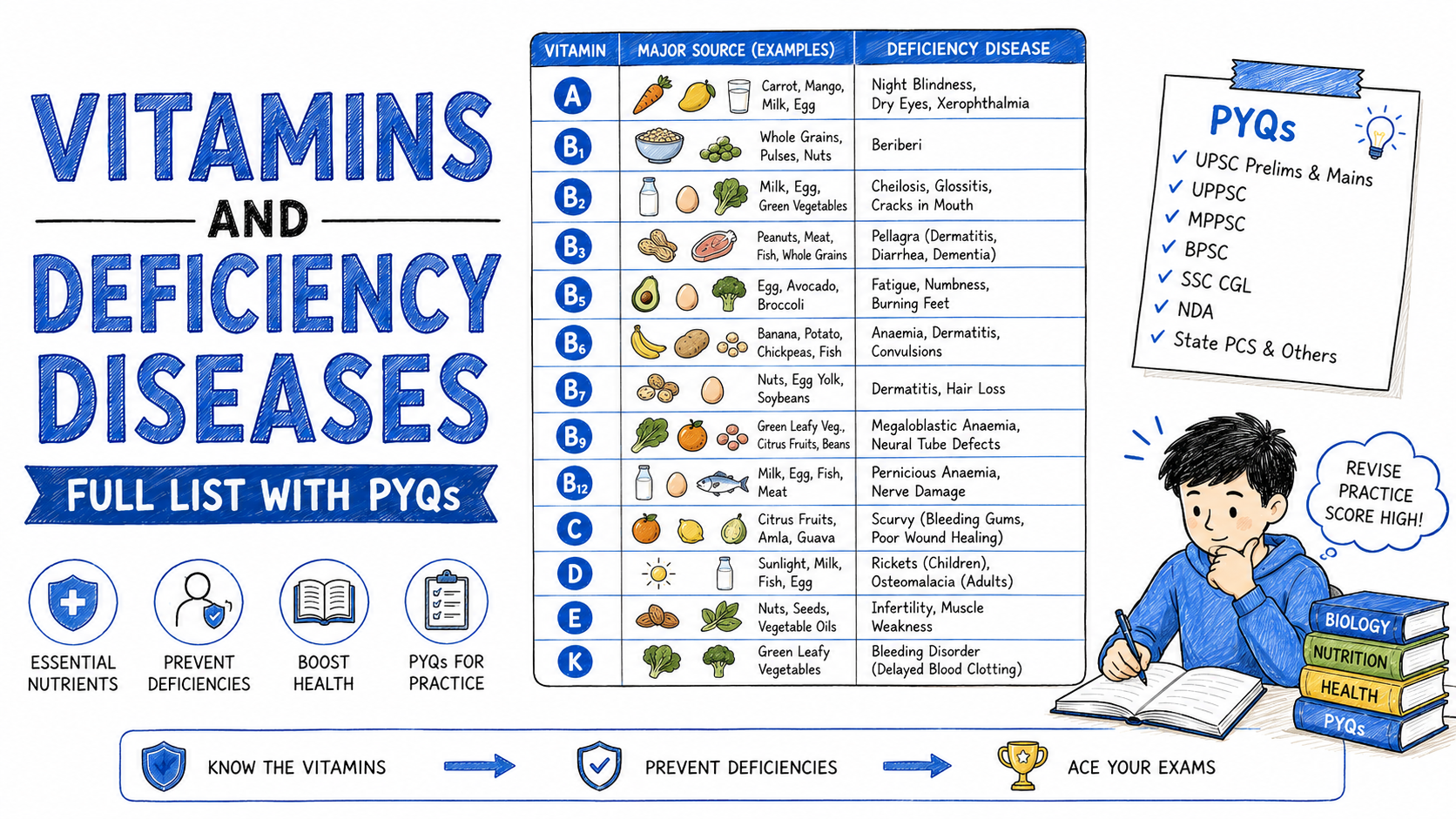
Vitamins is the most predictable topic in General Science. One question comes in almost every paper, and it always asks the same thing — which vitamin causes which disease, or what the chemical name of a vitamin is. There are only thirteen vitamins worth knowing, so the whole topic can be finished in one sitting and never revised again except in one page. This post gives the full list with chemical names, deficiency diseases and sources, and ends with 15 real questions from past papers.
Key Points (Quick Revision)
- Fat-soluble: A, D, E, K — these can be stored in the body
- Water-soluble: B-complex and C — these are not stored and must be taken daily
- Vitamin C deficiency causes scurvy; Vitamin D deficiency causes rickets
- Vitamin B12 is the only vitamin containing a metal — cobalt
- The term vitamin was coined by Casimir Funk
1. Fat-soluble and water-soluble vitamins
Every vitamin belongs to one of two groups, and this single division answers several questions on its own.
| Fat-soluble (A, D, E, K) | Water-soluble (B-complex, C) |
|---|---|
| Dissolve in fat and oil | Dissolve in water |
| Stored in the body, mainly in the liver | Not stored; extra amount passes out in urine |
| Not needed every single day | Needed regularly through food |
| Excess can be harmful | Excess is usually removed by the body |
Two extra points come from this table. Vitamin D and Vitamin K can be made inside the body — Vitamin D in the skin using sunlight, and Vitamin K by bacteria living in the intestine. And Vitamin C is destroyed by heat, which is why long cooking reduces the Vitamin C in vegetables.
2. Vitamins, chemical names and deficiency diseases
This is the main table of the topic. Almost every question comes from one of these three columns.
| Vitamin | Chemical name | Deficiency disease |
|---|---|---|
| Vitamin A | Retinol | Night blindness, xerophthalmia |
| Vitamin B1 | Thiamine | Beriberi |
| Vitamin B2 | Riboflavin | Cracked lips, skin problems |
| Vitamin B3 | Niacin | Pellagra |
| Vitamin B5 | Pantothenic acid | Burning feet syndrome |
| Vitamin B6 | Pyridoxine | Anaemia, convulsions |
| Vitamin B7 | Biotin | Hair fall, skin problems |
| Vitamin B9 | Folic acid | Anaemia |
| Vitamin B12 | Cyanocobalamin | Pernicious anaemia |
| Vitamin C | Ascorbic acid | Scurvy |
| Vitamin D | Calciferol | Rickets in children, osteomalacia in adults |
| Vitamin E | Tocopherol | Reproductive problems |
| Vitamin K | Phylloquinone | Delayed blood clotting |
Three pairs from this table are asked most often: C and scurvy, D and rickets, and B1 and beriberi. Learn the chemical names alongside them, because exams often name the chemical instead of the letter.
📌 Exam Focus
- Asked most often: scurvy (Vitamin C), rickets (Vitamin D), beriberi (Vitamin B1), night blindness (Vitamin A)
- Common trap: rickets is in children, osteomalacia is the same deficiency in adults
- Remember: Vitamin K is for blood clotting, not Vitamin C — both are confused in options
3. What each vitamin does and where it comes from
| Vitamin | Main function | Sources |
|---|---|---|
| A | Vision, healthy skin and eyes | Carrot, papaya, milk, egg, liver, green vegetables |
| B1 | Helps release energy from food | Whole grains, pulses, nuts |
| B2 | Growth and healthy skin | Milk, egg, green vegetables |
| B3 | Energy release and healthy skin | Meat, fish, groundnut, whole grains |
| B9 | Formation of red blood cells | Green leafy vegetables, pulses |
| B12 | Formation of red blood cells and nerve health | Milk, egg, meat, fish |
| C | Immunity, healing of wounds, healthy gums | Amla, orange, lemon, guava, tomato |
| D | Absorption of calcium, strong bones | Sunlight, fish, egg yolk, milk |
| E | Protects cells, reproductive health | Vegetable oils, nuts, seeds |
| K | Blood clotting | Green leafy vegetables, made by gut bacteria |
Two sources are asked directly. Amla has the richest Vitamin C among common Indian foods, and sunlight is the main source of Vitamin D, which is why it is called the sunshine vitamin.
Vitamin B12 carries one more fact worth keeping. It contains the metal cobalt, which makes it the only vitamin with a metal in it, and it is found mainly in foods of animal origin.
4. Mineral deficiency diseases
Exams often place a mineral among the vitamin options, so learn these together with the vitamins rather than separately.
| Mineral | Deficiency causes | Note |
|---|---|---|
| Iron | Anaemia | Iron is part of haemoglobin |
| Iodine | Goitre | Needed by the thyroid gland to make thyroxine |
| Calcium | Weak bones and teeth | Works with Vitamin D |
| Fluorine | Dental caries | Too much fluorine causes fluorosis |
| Phosphorus | Weak bones | Present in bones and teeth with calcium |
Note the fluorine point, because it is asked both ways. Too little fluorine causes tooth decay, while too much causes fluorosis, a condition that affects teeth and bones and is a real problem in several districts of India.
5. How it is asked in exams — 15 PYQs
- Deficiency of Vitamin C causes which disease? — Scurvy (SSC CGL 2023)
- Rickets is caused by the deficiency of? — Vitamin D (SSC CHSL 2023)
- The chemical name of Vitamin C is? — Ascorbic acid (SSC MTS 2023)
- Beriberi is caused by the deficiency of? — Vitamin B1 (RRB NTPC 2024)
- Night blindness is caused by the deficiency of? — Vitamin A (SSC CGL 2022)
- Which vitamin helps in blood clotting? — Vitamin K (SSC GD 2024)
- Which vitamin is called the sunshine vitamin? — Vitamin D (SSC CHSL 2024)
- Which vitamins are fat-soluble? — A, D, E and K (SSC CPO 2023)
- The chemical name of Vitamin B1 is? — Thiamine (RRB Group D 2024)
- Pellagra is caused by the deficiency of? — Vitamin B3 (SSC MTS 2024)
- Which vitamin contains cobalt? — Vitamin B12 (SSC CGL 2024)
- Goitre is caused by the deficiency of? — Iodine (RRB NTPC 2025)
- Which fruit is the richest source of Vitamin C? — Amla (SSC CHSL 2022)
- Who coined the term vitamin? — Casimir Funk (SSC GD 2023)
- The chemical name of Vitamin E is? — Tocopherol (RRB Group D 2023)
6. Quick Revision
⚡ Vitamin and disease pairs to fix in memory
- A Retinol — night blindness · B1 Thiamine — beriberi
- B3 Niacin — pellagra · B12 Cyanocobalamin — pernicious anaemia
- C Ascorbic acid — scurvy · D Calciferol — rickets and osteomalacia
- E Tocopherol — reproductive problems · K Phylloquinone — poor blood clotting
- Fat-soluble and stored: A, D, E, K · Made in the body: D and K
- Minerals: iron — anaemia · iodine — goitre · fluorine — dental caries, excess causes fluorosis
Frequently Asked Questions
What is the difference between fat-soluble and water-soluble vitamins?
Fat-soluble vitamins are A, D, E and K. They dissolve in fat, are stored in the body mainly in the liver, and do not need to be taken every day, but an excess can be harmful. Water-soluble vitamins are the B-complex group and Vitamin C. They are not stored, so they must come regularly from food, and any excess passes out in urine.
Which vitamins can the body make on its own?
Two of them. Vitamin D is made in the skin when it is exposed to sunlight, which is why it is called the sunshine vitamin. Vitamin K is produced by the bacteria that live in the intestine. All other vitamins have to come from food.
What is the difference between rickets and osteomalacia?
Both are caused by a deficiency of Vitamin D, but they occur at different ages. Rickets affects children, whose growing bones become soft and bend. Osteomalacia is the same softening of bones in adults. Exams place the two together as options, so the age is the deciding clue.
Why is Vitamin C lost during cooking?
Vitamin C is water-soluble and is destroyed by heat, so boiling vegetables for a long time removes much of it, and some of what remains passes into the cooking water. This is why fresh fruits such as amla, orange, lemon and guava are the more reliable sources.
How many questions come from vitamins in exams?
Usually one question per paper in SSC and Railway exams, and often one in state examinations with a science section. The pattern almost never changes — a disease is named and you identify the vitamin, or a vitamin is named and you give its chemical name. Since the list is only thirteen vitamins long, this topic can be mastered completely.
For more General Science topics in simple language, see the General Science section, and for related notes try our Human Body Systems post. Preparing for a specific exam? Start with the SSC CPO guide or join the 100 Hour GS Course.