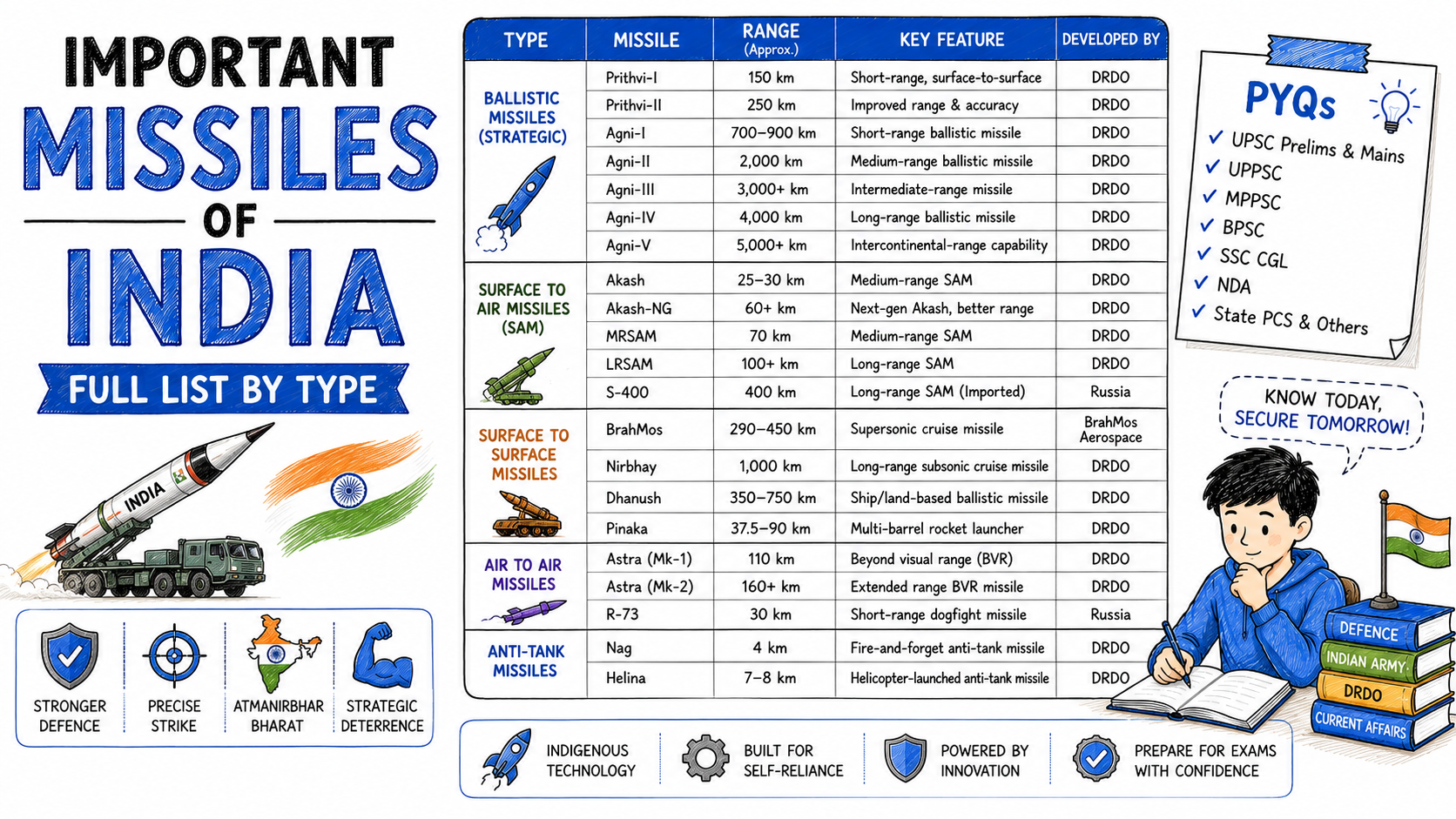
Missiles come up in almost every defence-related question paper, and in SSC and Railway exams they appear as a straight one-mark question — name the missile, name its type. The list worth knowing is short, about twenty names, and the categories rarely change. This post groups every important Indian missile by what it does, explains the difference between a ballistic and a cruise missile, and ends with 15 real questions from past papers.
Key Points (Quick Revision)
- All these missiles are developed by DRDO
- IGMDP was launched in 1983 under Dr APJ Abdul Kalam, known as the Missile Man of India
- The five IGMDP missiles: Prithvi, Agni, Trishul, Akash, Nag
- Agni is a ballistic missile family; BrahMos is a supersonic cruise missile
- BrahMos is an India-Russia joint venture, named after the Brahmaputra and the Moskva rivers
1. IGMDP — the programme behind the names
The Integrated Guided Missile Development Programme was launched in 1983 by the Defence Research and Development Organisation, and it was headed by Dr APJ Abdul Kalam. This is why he is called the Missile Man of India, and it is the most asked single fact in the topic.
| Missile | Type | Approximate range |
|---|---|---|
| Prithvi | Surface to surface | 150 to 350 km by variant |
| Agni | Surface to surface ballistic | 700 km and above by variant |
| Trishul | Short range surface to air | About 9 km |
| Akash | Medium range surface to air | About 25 to 30 km |
| Nag | Anti-tank guided | About 4 to 7 km |
The programme was formally completed in 2008, but the missile families it created are still in service and still being upgraded. Ranges quoted for Indian missiles differ between variants and are revised as new versions are tested, so treat every figure here as approximate.
2. Ballistic and cruise missiles — the difference exams ask
This one distinction answers several questions on its own.
| Ballistic missile | Cruise missile |
|---|---|
| Powered only at the start, then follows a high curved path | Powered throughout the flight |
| Travels very high, outside or near the edge of the atmosphere | Flies low, close to the ground or sea |
| Carries a heavier payload over a longer distance | More accurate, harder to detect on radar |
| Example: Agni series, Prithvi | Example: BrahMos, Nirbhay |
The simplest way to hold it: a ballistic missile is thrown, a cruise missile flies. One follows gravity after the boost ends, the other keeps its engine running and steers like an aircraft all the way to the target.
📌 Exam Focus
- Asked most often: BrahMos type (supersonic cruise), Agni type (ballistic), Nag type (anti-tank)
- Common trap: Pinaka is a multi-barrel rocket launcher, not a missile
- Remember: BrahMos is India and Russia; Barak-8 and MRSAM are India and Israel
3. Surface-to-surface missiles — Agni and Prithvi
These are the strike missiles, meant to hit a target on the ground from the ground.
| Missile | Approximate range | Note |
|---|---|---|
| Prithvi-I | About 150 km | Army version |
| Prithvi-II | About 250 to 350 km | Air Force version |
| Prithvi-III | About 350 to 600 km | Naval version |
| Agni-I | About 700 to 900 km | Short range ballistic |
| Agni-II | About 2000 km | Medium range |
| Agni-III | About 3000 km | Intermediate range |
| Agni-IV | About 4000 km | Intermediate range |
| Agni-V | About 5000 km and above | Longest range of the family |
| Prahaar | About 150 km | Short range tactical |
| Shaurya | Medium range | Land version of the K-15 |
Two points are asked from this table. Agni-V is the longest range missile in the Agni family, and the newer Agni-Prime is a lighter, more modern medium range version. Dhanush is the naval version of Prithvi, fired from a ship, which is a favourite one-line question.
4. Air defence, anti-tank and air-to-air missiles
| Missile | Type | Note |
|---|---|---|
| Akash | Surface to air | Medium range air defence, from IGMDP |
| Trishul | Surface to air | Short range, from IGMDP |
| QRSAM | Surface to air | Quick reaction, for moving armoured columns |
| Barak-8 / MRSAM | Surface to air | Joint programme with Israel |
| Nag | Anti-tank | Third generation, fire and forget |
| HELINA | Anti-tank | Helicopter launched version of Nag |
| Astra | Air to air | Beyond visual range, fired from a fighter aircraft |
Learn these by the launch platform and the target, because that is exactly how the question is framed. Surface to air means fired from the ground at an aircraft. Air to air means fired from one aircraft at another. Anti-tank means fired at armoured vehicles, and fire and forget means the missile guides itself after launch so the operator can move away.
5. Cruise missiles and naval systems
| Missile | Type | Note |
|---|---|---|
| BrahMos | Supersonic cruise | India and Russia; launched from land, sea, submarine and air |
| Nirbhay | Subsonic cruise | Long range, about 1000 km |
| Dhanush | Surface to surface | Naval version of Prithvi, fired from a ship |
| K-15 (Sagarika) | Submarine launched ballistic | About 750 km |
| K-4 | Submarine launched ballistic | About 3500 km, for Arihant class submarines |
| Pinaka | Multi-barrel rocket launcher | A rocket system, not a guided missile |
BrahMos is the name asked most often in this group, and three facts about it repeat. It is a supersonic cruise missile, meaning it flies faster than sound while keeping its engine running. It is a joint venture between India and Russia. And its name is formed from two rivers, the Brahmaputra of India and the Moskva of Russia.
Nirbhay is the pair to remember alongside it, because it is subsonic rather than supersonic but flies much further. And note the Pinaka trap: it is a rocket launcher system, so a question asking you to identify the missile in a list will place Pinaka there as the wrong option.
6. How it is asked in exams — 15 PYQs
- Who is known as the Missile Man of India? — Dr APJ Abdul Kalam (SSC CGL 2023)
- BrahMos is which type of missile? — Supersonic cruise missile (SSC CHSL 2023)
- BrahMos is a joint venture between India and? — Russia (SSC MTS 2023)
- Nag is which type of missile? — Anti-tank guided missile (RRB NTPC 2024)
- Akash is which type of missile? — Surface to air (SSC CGL 2022)
- Which organisation develops India's missiles? — DRDO (SSC GD 2024)
- IGMDP was launched in which year? — 1983 (SSC CHSL 2024)
- Which missile has the longest range in the Agni family? — Agni-V (SSC CPO 2023)
- Astra is which type of missile? — Air to air (RRB Group D 2024)
- Dhanush is the naval version of which missile? — Prithvi (SSC MTS 2024)
- Nirbhay is which type of missile? — Subsonic cruise missile (SSC CGL 2024)
- The name BrahMos comes from which two rivers? — Brahmaputra and Moskva (RRB NTPC 2025)
- Pinaka is a? — Multi-barrel rocket launcher (SSC CHSL 2022)
- Barak-8 is developed jointly with which country? — Israel (SSC GD 2023)
- HELINA is the helicopter launched version of? — Nag (RRB Group D 2023)
7. Quick Revision
⚡ Missile and type to fix in memory
- IGMDP 1983 — Prithvi, Agni, Trishul, Akash, Nag · headed by Dr APJ Abdul Kalam
- Ballistic: Agni, Prithvi, K-15, K-4 · Cruise: BrahMos (supersonic), Nirbhay (subsonic)
- Surface to air: Akash, Trishul, QRSAM, Barak-8 · Air to air: Astra
- Anti-tank: Nag, and HELINA from a helicopter
- Naval: Dhanush from Prithvi · K-15 and K-4 from submarines
- Joint: BrahMos with Russia · Barak-8 and MRSAM with Israel
- Not a missile: Pinaka — it is a rocket launcher
Frequently Asked Questions
What is the difference between a ballistic and a cruise missile?
A ballistic missile is powered only at the start and then follows a high curved path under gravity, travelling very high and carrying a heavy payload over long distances. A cruise missile keeps its engine running for the whole flight, stays low and steers like an aircraft, which makes it more accurate and harder to detect. Agni is ballistic; BrahMos is a cruise missile.
Why is BrahMos called BrahMos?
The name combines the Brahmaputra river of India and the Moskva river of Russia, marking the two countries that developed it together. It is a supersonic cruise missile, which means it travels faster than the speed of sound, and it can be launched from land, ships, submarines and aircraft.
Which missiles were part of the IGMDP?
Five missiles were developed under the Integrated Guided Missile Development Programme launched in 1983: Prithvi and Agni as surface-to-surface missiles, Trishul and Akash as surface-to-air missiles, and Nag as an anti-tank missile. The programme was headed by Dr APJ Abdul Kalam and formally completed in 2008.
Is Pinaka a missile?
No, and this is a common trap. Pinaka is a multi-barrel rocket launcher system that fires unguided or guided rockets in a salvo, not a single guided missile. Questions that ask you to pick a missile from a list often include Pinaka as the wrong option.
How many questions come from missiles in exams?
Usually one question per paper when a defence or science section is present, and more in defence entrance exams such as NDA and CDS. The pattern is almost always the same — a missile is named and you identify its type, or a type is named and you identify the missile.
For more Static GK lists in simple language, see the Static GK section, and for related science notes try our Human Body Systems post. Preparing for a defence exam? Start with the NDA exam guide or join the 100 Hour GS Course.